
Remembering Animal Communicator Teresa Whalen (Formerly Teresa Wagner)
Beloved animal communicator, Teresa Whalen (formerly Wagner) left this world September 22, 2026. I had known Teresa for decades. She trained in animal communication with Jeri Ryan, the first of my students to become a professional animal communicator in the early 1980s.
I experienced Teresa’s kindness and love for life when she joined a whale expedition to the Dominican Republic that I sponsored. Teresa hosted many whale communication journeys for decades, and we shared a passion for the wisdom of whales. We also found common ground in our counseling training and childhood experiences.
Teresa’s life and work were featured in the following article from Species Link: the Journal of Interspecies Telepathic Communication, the magazine I published, in Issue 56, Autumn 2004.
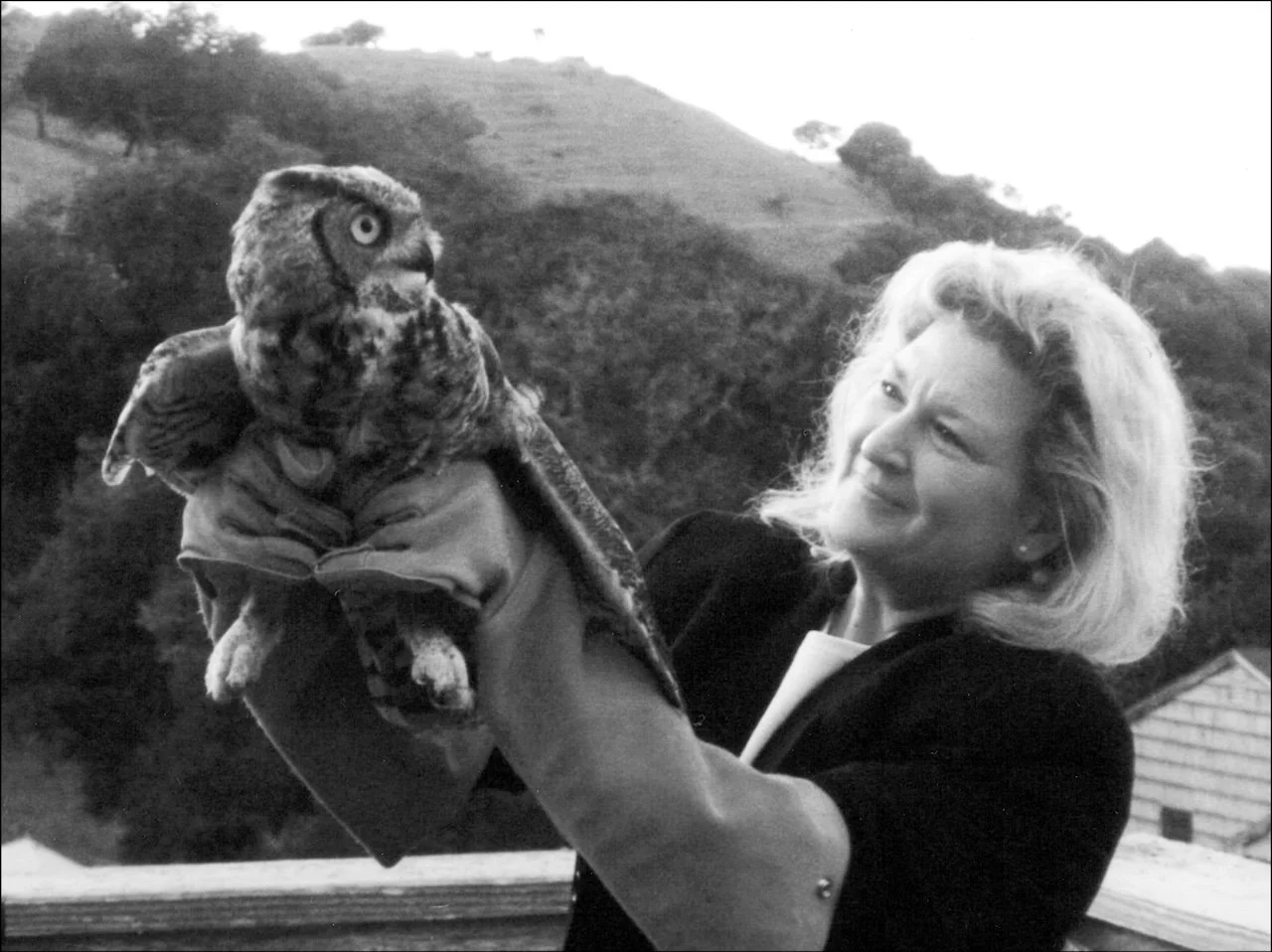
Photo of Teresa and owl taken at the SPCA Monterey County California Wildlife Rehabilitation Center
Whatsoever Things Are True
Featured Communicator • Teresa Wagner
When animals die, grief counselor Teresa Wagner helps their humans make sense of it all.
By Brenda Fullick
Why is it that when we lose our beloved animals, society says that our mourning is merely practice for "the real thing" - that losing a fellow human is the one, true grief?
Why do so many people assume that animals are simply companionship stand-ins for the truly needy among us - vulnerable children, the lonely elderly, desperately single people who can't find spouses to love them?
And why is it that so many ministers tell their parishioners that God doesn't want them to mourn animals as deeply as they'd mourn humans? Why do so many religious teachings say that, although animals are God's creatures, they are still below humans and we are required to love them less?
Grief counselor Teresa Wagner is outraged by an attitude prevalent in many churches, psychology books, and a whole lot of contemporary American minds, an attitude that goes something like this: Get over it. It was just an animal. You can always get another one.
As Teresa sees it, people can be particularly influenced - and hurt - by these attitudes while they're in the midst of grieving the passing of animal souls who had brought such emotional safety and sweetness to their lives. While people are desperate, they may be too ready to believe sanctimonious clergy or patronizing therapists, thus denying their own truths - or they may retreat even further from humans into the comforting world of other animals, the only souls who seem to understand.
But Teresa understands.
She challenges societal assumptions in her animal communication practice, and in her audiocassette tape set, "Legacies of Love."
"My question is, what kind of God would ever ask us to withhold our love for anyone?" she asks. "Or what kind of God would create a hierarchy of loving, or a hierarchy of grieving?
"Certainly not the same God who created animals."
Who Can You Trust?
Like many communicators, Teresa has known times when the only people she could trust were animals. Her earliest childhood memories involve communicating with the black-and-white tuxedo cat who kept her sane.
Each time her father finished raping her and walked out of her bedroom, Teresa's best friend Catnip would show up on her pillow and speak to the little girl. "You're going to get to leave this someday," Catnip kept promising. "Life will be good.”
This went on for years.
Teresa grew up somehow thinking that she could hear the thoughts of dogs and cats only because her father was raping her. She's careful now to tell her students that they don't have to come from abusive pasts to communicate with animals; however, the terrors of her childhood deepened her connection with all animals.
Teresa remembers visiting a park one day with her mother. "This one large duck came up and said, 'You know, I'm very sick and I'm dying, and I feel your love and I wanted to connect with you." The duck said his body was hurting, and he just needed some extra love. Little Teresa began to cry.
"My mother came over and made some big ugly joke about how I was crying because the duck couldn't quack," Teresa remembers.
She decided, at that moment, that she couldn't tell another human about her conversations with animals.
Fast forward to today. Teresa offers all sorts of animal communication consultations, but she specializes in grief therapy. She also teaches courses on animal communication, including courses to help communicators become better healers while taking care of themselves.
After years of study, work, and introspection, Teresa knows that one of her major life lessons has been learning to trust humans. But maybe she'd never have been able to connect with humans at all if animals hadn't been able to reach her first.
After all, she spent her first 40-some years on this planet trusting only animals.
Who, then, can judge the depth of this human-to-animal connection? Isn't it really about fragile hearts learning how to love?
Revolutionary Ideas
Teresa was trained as a traditional therapist. Early on, she was transformed by her opportunity to study under the influential Carl Rogers, the first non-M.D. to practice psychotherapy in the United States and considered the father of humanistic psychology. Instead of prescribing drugs and telling people what was wrong with them, he focused on listening to clients and creating a respectful empathy that allowed them to safely explore their own feelings.
"I remember feeling in my heart, this is the truth of how it is," Teresa remembers. "This is what helping is all about."
Teresa incorporated those ideas when she built a successful career back East, where she would work as an in-house therapist for executives. She handled human resources for corporate America and became a fabulous success.
Heck, she could afford to wear furs.
And, of course, that wasn't nearly enough.
The first really big sign that life had more in store for Teresa came in 1985, when she suffered her first major loss as an adult: the death of one of her cats. Her vet watched the way she worked through the grief process with the help of another therapist, and he knew Teresa had a special gift. The vet took her aside and said, "Now I need you to help my clients."
So Teresa began hosting support groups in Philadelphia, acknowledging the depth of her clients' mourning over the loss of the animals in their lives. By doing this, she was stepping outside the box, outside the cage.
"People who love animals as soul peers ... take a lot of flack from some of the traditional clinical community," Teresa explains. Clinical literature says humans just shouldn't love animals that much. It isn't normal.
But what is normal? And who's to judge?
According to standard psychology texts, Teresa says, "the goal for all humans should be to love another human in a mate situation—that if they have an animal family only, they're still hiding from their wounds."
In Teresa's support groups, it was suddenly okay for a woman to admit she loved her dog more than her husband. Ever so politely, Teresa was beginning to thumb her nose at the paradigm.
And then there was this whale. It was 1988. For Teresa, there would be no going back.
'I recognized family'
Teresa and a friend drove from Philadelphia up to Cape Cod for her first weekend of whale-watching. For more than an hour, one whale stayed beside the boat and talked to Teresa.
"I just was mesmerized," she remembers. "As soon as he came, I recognized family. I knew I was in the presence of somebody who knew me and loved me."
The whale asked Teresa how she could eat the bodies of cows, how she could wear the skins of foxes.
"He said, 'Teresa, if you love us and your cats’—he knew I had cats—‘if you love us, it's just something we'd like you to think about.' ... The thing that was really significant about this was the absolute lack of judgment. It was softer than a suggestion. That's when I became a vegetarian. Not because someone forced me. It took this whale to get me to see it all, so I changed my life overnight.
"All of a sudden, I couldn't hide anymore that I could talk to animals," she says. "My heart just burst open. I would walk down the streets of New York, and I would talk to pigeons."
For a while, Teresa kept her fancy H.R. job at RCA, pulling down big scratch, outwardly shiny and successful. It took a corporate buyout and a mass layoff to push Teresa toward her future. She began juggling freelance corporate work with counseling for people grieving over animals.
The pet-loss therapist was still essentially a closet communicator until she moved to California and started spending time with the likes of Penelope Smith and Jeri Ryan. One day, Jeri went on vacation and left Teresa's number on her answering machine for clients to call in case of emergency.
The snowball was on its way down the mountain.
For a while, Teresa kept a paw in both worlds, subsidizing her fledgling career as a communicator with her more lucrative consulting work. She was jetting all over the country, teaching managerial sales courses, helping big companies with strategic planning, showing corporations how they could use psychology to be more financially successful.
Suddenly, all that became sort of dull.
Dull compared to what she knew makes humans really tick: the heart-level terrain Teresa could explore as an animal communicator. In 1995, she gave up corporate jobs completely for the work that spoke to her most deeply.
Sharing the Wealth
Teresa now offers private consultations integrating Carl Rogers' techniques with what she understands about the bond between humans and animals, while also opening her philosophical cupboard to other communicators.
As a therapist, she doesn't believe it's her place to judge what people believe about the Big Questions of life. Or who people choose to love and mourn. Or how long they need to stay in grief before they're ready to come out the other side. As long as humans are aware of their wounds and committed to healing them, she says, "the pace with which we heal them doesn't matter."
Teresa maintains that any professional - an animal communicator, a hairdresser, a medical doctor, an accountant—has a responsibility to treat clients respectfully, without judgments, while offering the technical expertise. "Probably the most important thing," she says, "is radiating a sense of compassion, love, and warmth."
Before each consultation, Teresa advises communicators to shield themselves energetically, using crystals, flower essences, an image of light, or any method that projects the intention of protection. They can then avoid taking on the clients' emotions, which enables them to keep a clear distance while really hearing what the client is saying.
Teresa describes three levels of listening: intellectual empathy (which she taught in corporate America), emotional empathy (listening to how people describe their feelings), and the richest territory of all, soul empathy: hearing the energy below the words, the things that go unsaid.
"When we go to the soul level instead of just the feeling level," Teresa says, "we're always going to see the light."
Communicators should use gentle questions with humans to gain clarity, Teresa advises, helping the clients reach their own conclusions rather than leading them toward what the communicator believes to be true. "To me, being an accurate telepath is the beginning," she says. "The ultimate gift of the healer is to allow the other person their own path.
"I work with a lot of people who are still in great pain," Teresa says. "Part of being a good healer and counselor is being able to deal with the ambiguity that at the end of the session, everything is not fixed.... It takes a real commitment to do what Carl Rogers said all those years ago, to really be able to live with that ambiguity, to offer compassion and great love and help the person gain clarity about what they want to believe."
Many of Teresa's clients come from strong Christian backgrounds. When Scruffy dies and the priests insist that dogs don't have souls, vulnerable clients turn to her in desperation: Where do animals go when they die? What's it like for them?
Like many communicators, Teresa has an ego that wants to shout, "of course dogs have souls." Still, she doesn't think it's ethical to pass off her own understandings as Truth.
"My belief is so strong that when it comes to something as huge as our belief system, nobody has any right to tell anybody else this is exactly what happens," she says. She might, if pressed, say what she thinks at this moment; more likely, she'll suggest that they check in to see what the client's animal is experiencing.
It's not always easy to simply listen and relay information between the client and the animal without coloring the discussion with the communicator's own bias. Especially when the communicator just wants to fix things and make everything better.
"It's not about being the hero," Teresa says. "This work is not about the ego. It is about service .... Our job, with whatever techniques, is to literally shed light on the other being's situation so they can see where to go from there."
For instance, Teresa is a big advocate of spaying and neutering—for all the reasons that so many animal lovers know by heart. But when someone calls wanting to know whether Fluffy wants to have a litter of her own, Teresa has to put all that aside.
"My job is to talk to Fluffy, and ask Fluffy what Fluffy wants," Teresa says. "When I hear the Fluffys say 'I want to have babies,' that's when I know I'm being really clear."
Creating Beauty from the Loss
When we dare to love them, we're going to lose them. In her audio recording set, "Legacies of Love," Teresa Wagner offers steps that humans can follow to move through the kiln of infinite sadness to forge something beautiful and lasting:
Find ways to comfort yourself. This may mean lots of bubble baths, prayer, and walks in nature. It may mean going out for a good meal, or reading a good book. "Remember, you are recuperating, just as you would be as if you had had surgery. Be gentle with yourself. Give yourself time to heal.”
Complete your unfinished emotional business. If you secretly worry that you opted for euthanasia too soon, or you should have made sure that gate was latched, now's the time to face your issues and let them go. Maybe you want to apologize to the animal's spirit. Maybe you want to decide how you'll handle things differently the next time. Or maybe you just need to forgive yourself, because you probably did do your very best at the time.
Be grateful for the gifts you've received in the relationship, and decide how you can honor the animal's legacy by incorporating his qualities in the way you live your own life from now on.
"Just as we would want to wisely invest a financial legacy so it grows, we should wisely invest and use the legacies of love and other gifts from our animals, so those gifts grow, too," Teresa suggests.
"When we lost our beloved animals, our hearts were broken. And when hearts are broken, they are open - open not only to pain, but also to new ideas, growth, and transformation."
You can read more of Teresa’s writing on my website, including her contributions on animal rescue and welfare, and her article, How to Use Animal Communication Effectively for Behavior Problems.
To learn more about Teresa’s work, visit Animals in Our Hearts.
Following Teresa’s wishes, Animals in Our Hearts will reopen under the gentle stewardship of Jonquil Williams.
Jonquil’s connection with Teresa spanned more than 20 years. She began as a frequent client, then studied animal communication and became a professional animal communicator in 2010 under Teresa’s guidance. She also took Teresa’s online grief classes and continued learning through private mentoring. Over the years, their relationship grew into a close friendship rooted in mutual love and a shared spiritual understanding.
A Reiki master with three certifications and 24 years of experience in Animal Reiki, Jonquil has also offered healing energy and animal communication to Teresa’s beloved cat KK. Following Teresa’s wishes, KK was gently settled into a new home with a couple who have known him since he was a kitten.
Jonquil is deeply committed to carrying Teresa’s legacy forward. Once the legal transfer of Animals in Our Hearts under Teresa’s trust is complete, the website will retain its familiar character, with Jonquil’s presence woven into the work and words Teresa leaves with us.
Please watch the Animals in Our Hearts website for news of its reopening.